Yearly Archives: 2011

The Sunken Past: Shipwrecks Lost in Translation

UNESCO – To Dig Or Not to Dig?

The question of to dig or not to dig has deeply divided marine archaeology over the last decade. In a hyper-urbanized world, whose seas increasingly reveal shipwrecked wonders, is it nobler to look and not touch, preserving what exists for future generations in an eco-friendly bubble? Or does society have an obligation to excavate, study and publish to expand the sum of finite human knowledge scattered across the seven seas?

Since UNESCO’s Convention on the Protection of the Underwater Cultural Heritage was adopted in 2001, the concept of in situ preservation has taken centre stage in the theatre of marine archaeology from high government departments to the living rooms of bemused weekend wreck divers. Today the idea has morphed into arguably the most politicized and controversial Frankenstein in the history of underwater archaeology.

The producers of the Convention play are naturally familiar with their script, but the cast seems to have been left scratching its head. At many levels of university life, heritage management, and especially amongst the grass roots of the global shipwreck diving community, managerial confusion reigns supreme.

Numerous international conferences and meetings convened and attended over the last decade by heritage managers, contract archaeologists and commercial archaeologists leave no doubt that the core sense of in situ preservation has been lost in translation. It was specifically to help ‘unmuddy’ these waters that Wreck Watch initiated a questionnaire in August 2011 to explore the meaning and reception of this principle, especially to inform practitioners at the grass roots level.

Titanic – Dive & Study or Leave & Memorialize?

The 2001 UNESCO Convention was originally drafted to combat ‘treasure hunting’, which was considered by a powerful union of bureaucrats and heritage managers to be the major destroyer of underwater cultural heritage. Certainly, there is no doubt that some projects, epitomized by the salvage of 350,000 artefacts from the Tek Sing (lost 1822), grossly neglected the value of contextual archaeology. UNESCO rightly raises similar concerns over the Geldermalsen (wrecked near Singapore in 1752) and the Titanic.

To its credit the Convention has increased public awareness about the ethical indecency of plundering wrecks. Truth be told, however, treasure hunting was already far down the road to extinction by 2001 as self-imposed enlightenment led to the emergence of commercial marine archaeology, which in cases displays impressive skills of project planning, site recording, publication, fundraising, public education and media outreach.

Designed to exterminate a fading threat, in situ preservation was instead reinvented as a broader tool to protect underwater cultural heritage at risk from a host of threats and ill-conceived excavation. Custodians who had successfully cared for the submerged past for decades now found themselves on the wrong side of the law as in situ preservation was heralded in government circles as the preferred and ideal option.

At a session focused on ‘In Situ Preservation’ at the Institute of Archaeologists’ annual conference at Southport, England, in April 2010, in situ was described in separate talks by two university professors as UNESCO’s preferred approach (which Ulrike Guérin dispelled at the event as inaccurate). Widespread confusion and trepidation peppered the conference on maritime archaeology convened at the Asian Civilizations Museum, Singapore, in June 2011 alongside serious concern that in situ clashes with much of Southeast Asia’s chosen governmental modus operandi.

And in the recent Ministry of Defence and Department of Culture, Media and Sport response to the public consultation over the fate of HMS Victory (1744) the idea of in situ “was in the main favoured by archaeological bodies, many of whom pointed out that in situ management of historic wreck sites was the preferred option of the guidelines set out in the Annex to the 2001 UNESCO Convention for the protection of the Underwater Cultural Heritage”. An arc of continuity links this document with the Burlington House seminar on the UNESCO Convention held in London in October 2005 by the Joint Nautical Archaeology Policy Committee, the Society of Antiquaries of London, the Nautical Archaeology Society, the Council for British Archaeology and the UNESCO UK Committee, where one prominent speaker stated that the 2001 Convention provides for “conservation & maintenance of archaeological heritage, preferably in situ”, accurately reflecting the tone of the assembly.

Serious concern over the incompatibility of in situ preservation with traditional excavation partly underlies the Penn-Brock Statement of Principles and Best Practices for Underwater Archaeology and the Stewardship of Underwater Cultural Heritage in the Mediterranean released in November 2010 following two conference consultations with leading specialists, especially university personnel, working specifically in the Mediterranean Sea. A summary of the opinions derived from these events heightened sensitivity that “Intrusive explorations, moreover, are potentially in conflict with the concern for in situ preservation articulated in the 2001 UNESCO Convention (Annex Rule 1) and raise questions about what circumstances justify such an intervention, who is properly qualified to undertake different types of research related to UCH, and who has the authority to make these decisions.”
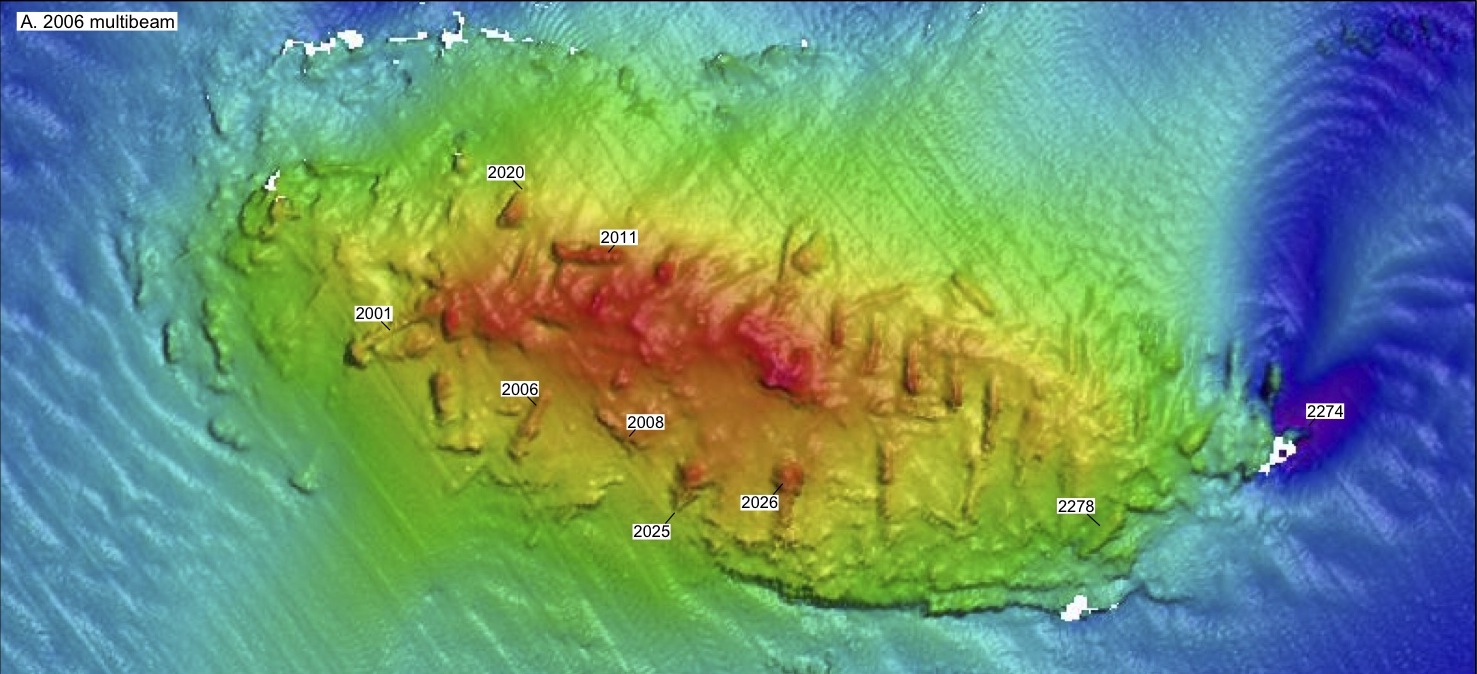
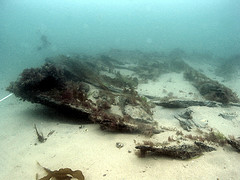
Stirling Castle, 1703: Are Annual Multibeam Surveys Good In situ Preservation or Managed Neglect? © Wessex Archaeology, 2009.

As a consequence, reference to and recommendation of in situ preservation was conspicuously dropped from the resultant Penn-Brock Statement, which instead loosely stipulated that “Archaeological research plans should set preservation and the advancement of knowledge as their primary objective”. In my view the perceived tension between excavation and in situ preservation strongly underlay the formulation of the Penn-Brock Statement, in tandem with growing concern that the UNESCO Convention has been disproportionately directed by bureaucrats and lawyers, instead of by the protagonists of underwater archaeology.

Many maritime stakeholders are deeply worried that their interests are being ignored by governmental heritage bodies to paper over cracks in State managerial and budgetary failings. In the case of the Stirling Castle, a Royal Navy warship lost off southern England’s Goodwin Sands in the great storm of 1703, and the best preserved pre-modern hull in UK territorial waters, long-term licencee Robert Peacock fears that UK heritage departments are hiding behind the UNESCO Convention (‘Management of Neglect’, Advisory Committee on Historic Wreck Sites. Annual Report 2008, 16-17). While deeply buried sites can be managed in situ off the UK, in the case of the Stirling Castle he has found through annual monitoring “that by adopting in-situ preservation the site has been left to be physically destroyed by the elements over the last 10 years with no protection. If this is how we are to manage our protected sites (which I can accept) then we must consider changing the wording from “preservation” (which it is clearly not) to “staged and managed neglect”. Comparable strong opinions span the cross-section between grass-roots avocational wreck divers and university lecturers.

Questionnaire Results

Uncertainty about how UNESCO intends in situ preservation to be interpreted lay at the heart of the 2011 Wreck Watch questionnaire, which was submitted to marine archaeologists/archaeological divers who have managed an underwater project or served as a supervisor on such a project; to university personnel who teach/support marine archaeology; heritage personnel (museums, charitable bodies, independent organizations) involved in management issues and policy in marine archaeology; and specialists involved in the study of artefacts derived from underwater cultural heritage (eg. conservators, ceramic/hull analysts).

The 58 respondents well represented these classes with the exception of commercial archaeology, which was under-represented in the number of replies:

• Marine archaeologists: 27%

• Contract archaeologists: 21%

• University lecturers: 17%

• Government heritage managers: 15%

• Commercial archaeologists: 10%

• Naval historians: 7%

• Conservators: 3%

From the total respondents, 57% felt that as an overall fundamental management policy the application of in situ preservation to underwater cultural heritage is a positive strategy. A further 46% felt that it was not. Rated between 1 and 10 (1 negative and ten positive), the impact of in situ preservation as a management tool received a current operational credibility rating of 54%.

Disagreement existed concerning whom this management tool is aimed at, with 63% of respondents answering that it was applicable to all stakeholders (contract archaeologists, commercial archaeologists and university projects). The remaining respondents provided multiple replies in which 25% indicated that the policy was not intended for contract archaeologists, 17% felt that it was not relevant to commercial archaeology and 21% excluded university projects as within its remit.

This polarized reception was qualified by personal statements that oscillated widely in understanding and, indeed, sentiment. A UK protected shipwreck licencee pointed out that if followed literally in situ preservation would have prevented the excavation and recovery of the Mary Rose and the Invincible and felt that “In a single generation we are witnessing the birth, ascendance and decline of underwater archaeology”. Another marine archaeologist commented that “In situ preservation has no supportive scientific evidence. In situ preservation has overwhelming scientific contrary evidence.” Several experienced field practitioners expressed serious concerns about the politicized “widespread canonical application” of the concept, which “can be implemented in a stupid and dysfunctional way, as a prohibition tool, by incompetent, hypocritical, lazy, or just plain stupid bureaucrats…”

On a more accommodating note, the majority of respondents stressed that the idea of in situ preservation should be proactive and is not an excuse for management to do nothing. One balanced comment emphasized that “For many national authorities and institutions in situ preservation seems to be the ONLY option in the management of the UCH. In this sense the UNESCO 2001 convention, for example, has been misinterpreted. OTHER management options (excavation, recovery etc.) are just as valid, especially if the archaeological potential of a given site is to be fully recognized, documented and presented to the public.”

In a similar vein a State marine archaeologist stressed that “When used correctly in situ preservation facilitates future/longer term research, educational/outreach activities and tourism. The methodology has, however, been used as an excuse to do nothing and watch sites deteriorate. The latter is not in situ preservation. In situ preservation requires active intervention. Not all sites are suitable for the use of in situ preservation, but many are.”

Many respondents, including government representatives, strongly felt that shipwrecks should be considered on a case by case basis since in situ “is not always practicable or efficient as depending always on the particular situation of each shipwreck… Sometimes to preserve better a shipwreck is needed to be rescued on the surface than to leave it on the sea bottom, to be restored and conserved with special treatment in the lab.” When applied correctly, “The policy of in situ preservation makes everyone aware that all factors at every site should be considered before excavating (destroying) a site”, in the words of another State marine archaeologist to bring “responsibility and respect for the unknown: the untold story in the relationship of the objects to each other, the unique record laid down in the interaction of the objects with the sea. And what can be learned from that, rather than being simply materialistic or trophyist about the past.”

A cross-section of all respondents’ comments is presented at the end of this article.

To Dig or Not to Dig?

The Wreck Watch questionnaire reveals that despite more than ten years having passed since the UNESCO Convention was adopted, both signatories and countries which have chosen totemically to adhere to its Annex (without having ratified the Convention) have failed to disseminate the correct meaning of in situ preservation as a managerial tool as understood by UNESCO. The reasons for this omission are best left to the various national stakeholders to enquire of their UNESCO representatives.
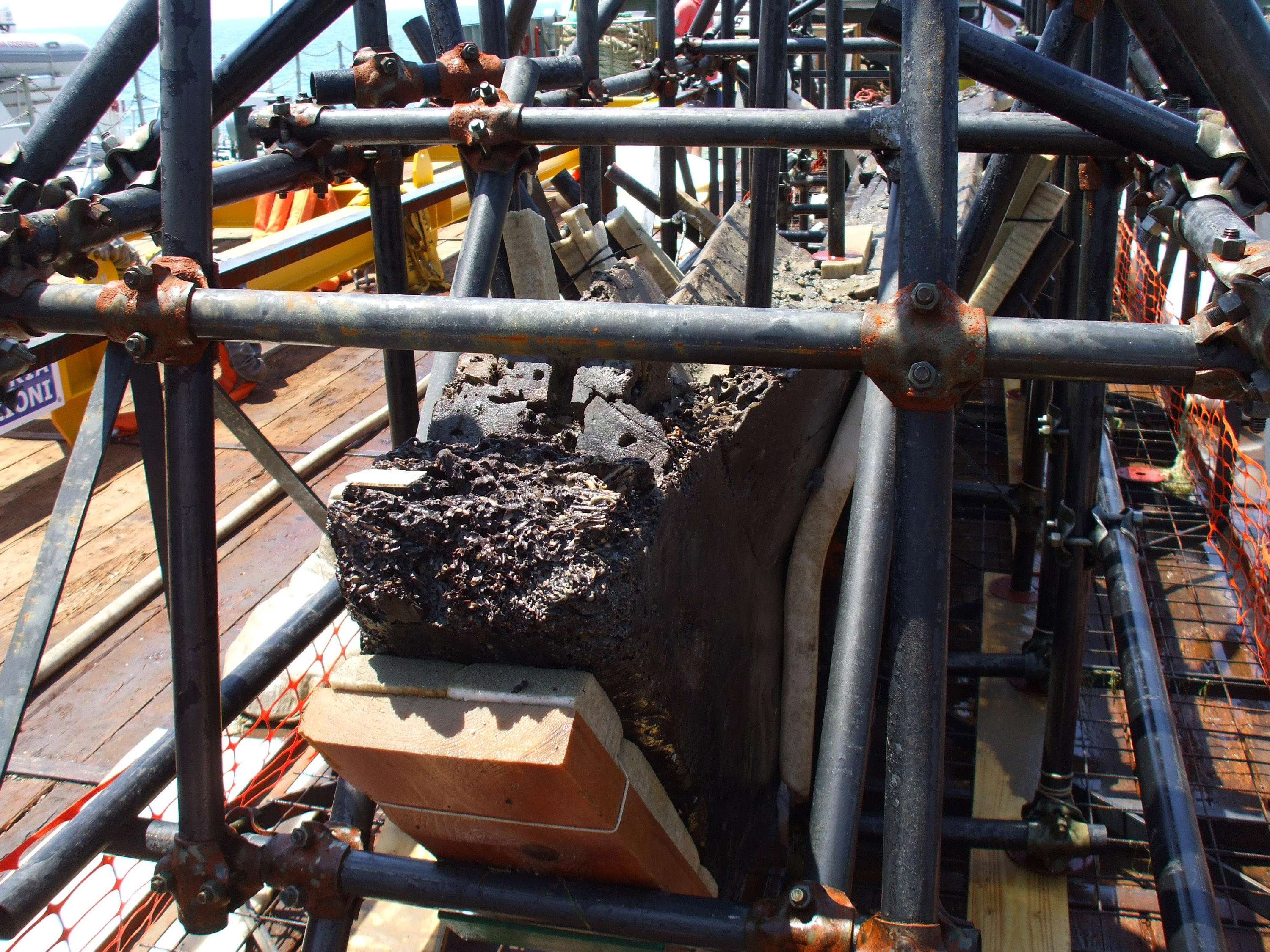
Gela Ship, Sicily, 5th Century BC.

At least on paper the true meaning of the concept is clear. As early as 2002 the history of the Convention was clarified by Patrick O’Keefe in Shipwrecked Heritage: a Commentary on the UNESCO Convention on Underwater Cultural Heritage (Leicester, 2002). As well as discussing the issues of ‘creeping jurisdiction’ over the continental shelf and security considerations relating to marine access for naval purposes that continue to prevent the major maritime powers ratifying the protocol, O’Keefe very concisely explains in relation to Annex Rule 1 that:

“It is quite clear that this provision does not prohibit work on the site of underwater cultural heritage or even its excavation. In situ preservation is the first option only. If interference with the site can be justified then it may be authorized. Justification may consist of the need for scientific investigation of the site to establish what lies there; to save material from a site threatened by development, natural deterioration etc… Any decision to excavate for the purpose of making a scientific contribution to knowledge must be made with a full understanding of other techniques that may be available. These may not have the glamour of an excavation but may be more cost effective and provide the answers sought.”

As to criticisms that in situ preservation is inappropriate for shipwrecks that are continually deteriorating or being destroyed by industry, such as dredging operations, O’Keefe clarifies that “these criticisms ignore the fact that in situ preservation is only the first option. If a wreck is going to be destroyed, for example, during pipeline laying, and there is no way of avoiding it, then it can be excavated.”

Precisely the same interpretation is presented by Ole Varmer (in S. Dromgoole, ed., The Protection of the Underwater Cultural Heritage. National Perspectives in Light of the UNESCO Convention 2001, Leiden, 2006: 376), who echoes that “The first option is in situ preservation, but recovery is authorized if consistent with the annexed Rules.” In 2008, Martijn Manders stressed in Museum International (‘In Situ Preservation: the ‘Preferred Option’’, 2008: 31-41) that in regard to in situ preservation “It is, however, important to note that it forms just one part of management, and not – as often interpreted – the only right way forward. Excavation and preservation ex situ remain options for consideration, but must be backed up with strong arguments and a detailed description of planned execution.”
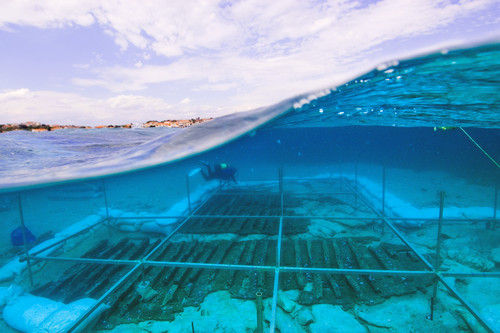
Late Roman Wreck at Pakoštane, Croatia. © P. Groscaux/UNESCO.

More recently, Craig Forrest agreed in International Law and the Protection of Cultural Heritage (London, 2010: 341-2) that “The principle of in situ preservation does not therefore mean that underwater cultural heritage is never recovered, only that it is recovered for a sound reason, and only after pre-disturbance archaeological investigation has been undertaken”, specified as protection from site looting, if wrecks/artifacts are exposed by, and at risk from, a storm or due to natural environmental conditions.

All of these sources readily accessible within scholarly literature expose the current climate of fear swirling around shipwreck management to be either a case of utter misunderstanding or conscious scaremongering. Nevertheless, it has taken UNESCO itself a decade to publish its explanatory Underwater Cultural Heritage and the Rules of the UNESCO 2001 Convention: a Manual (Th. Maarleveld, U. Guérin and B. Egger, eds., UNESCO, 2011), which categorically leaves no room for posturing or politicizing in the future.

Somewhat controversially, UNESCO argues in the manual that any misunderstanding in the wording of Rule 1 (“The protection of underwater cultural heritage through in situ preservation shall be considered as the first option”) is “nurtured by those who do not want any regulation to curtail their interests”, which this questionnaire suggests is inaccurate. Finally and crucially, the document confirms that “However, ‘first option’ is not the same as ‘only option’, or ‘preferred option’. Partial or total excavation may be necessary under certain circumstances and preferable for a number of reasons. Reasons may be external, such as development projects for which many sites need to make way. If their character is fully understood, some sites will be considered sufficiently significant to warrant their preservation in situ in spatial planning processes. This is very unlikely, however, to be the case for sites whose existence or significance is unknown or only vaguely indicated until development is well underway… Another external reason for excavation is the need to secure a site’s continued existence, due to instability of the environment, or due to the fact that stabilizing it would be so exorbitant in cost that in situ preservation would not be the preferred option at all. However, none of these reasons should prevent considering in situ preservation first. This applies to both the initiator and the authority who considers authorization.” After criticizing with some paranoia the “very creative” means identified by initiators of projects “in finding and formulating reasons for excavation by amplifying the magnitude of vigorous threats to a site” (which surely equally relates to heritage bodies inventing reasons to bar excavations), the UNESCO manual concludes by reiterating that:

“Rule 1 explicitly mentions three overall purposes for which activities directed at underwater cultural heritage can be authorized. These substantive reasons are:

• a significant contribution to protection, or

• a significant contribution to knowledge, or

• a significant contribution to enhancement.”
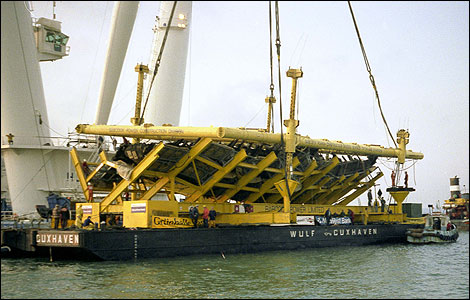
The Mary Rose: Never Again or Positive Education?

The manual’s final commentary encourages, yet cautions, that “In exceptional cases, a very good research design, addressing pertinent research questions, can be reason enough to sacrifice a stable site through excavation. However, it is certainly not the first option, and needs to meet the maximum requirements of state-of-the-art archaeological projects.” Underwater Cultural Heritage and the Rules of the UNESCO 2001 Convention: a Manual is published online in ‘Tutorial on the Rules Concerning Activities Directed at Underwater Cultural Heritage’. For a greater understanding of what in situ preservation means and involves, see the important results of the questionnaire on ‘In-situ Preservation and Storage: Practitioner Attitudes and Behaviours’ (N. Ortmann, J.F. McKinnon and V. Richards, Bulletin of the Australasian Institute for Maritime Archaeology, 34, 2010: 27-44) and the resources listed below.

Much Ado About Nothing?

The 2011 Wreck Watch questionnaire flags up the concerns and, in many circles, the distrust of the spirit of in situ preservation imposed on marine archaeology today. This is regrettable and unnecessary. The various scholarly explanations of the Convention on the Protection of the Underwater Cultural Heritage reveal UNESCO’s true meanings and expose the current furore as much ado about nothing. How this meaning has failed to be faithfully disseminated to government and heritage bodies, universities and avocational wreck divers is a disturbing trend that demands serious questions be asked of national UNESCO representatives.
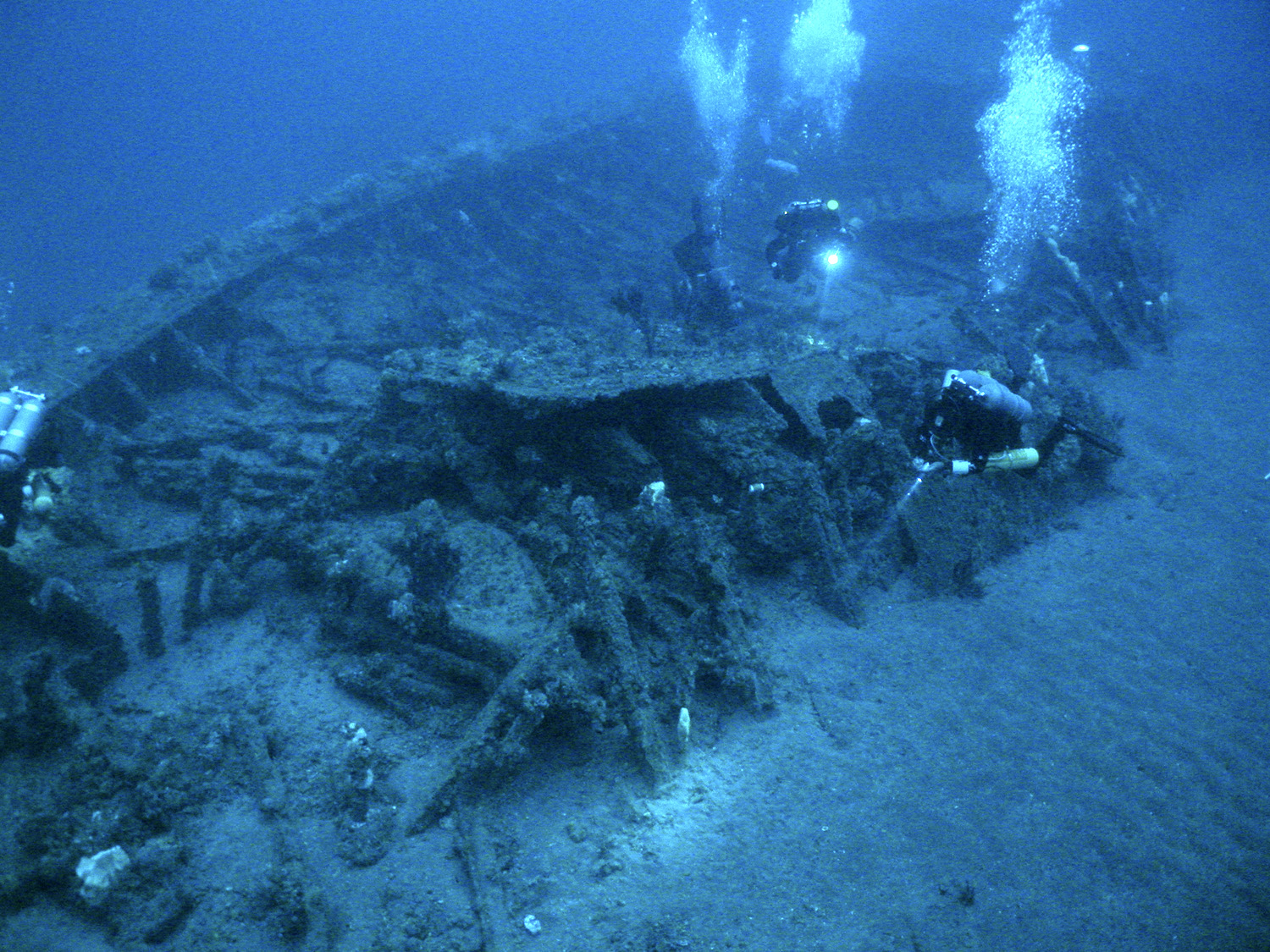
Diving the USS Monitor off North Carolina. © NOAA.

Truth be told, as potent a tool as survey has long been within archaeology, ever since John Ward-Perkins directed the South Etruria survey between the 1950s and 1970s, it is meaningless without knowledge obtained from excavation. Closed shipwreck assemblages have not only vastly tightened ceramic chronologies of all periods on land – the very foundations of stratigraphic archaeology as a science – they are the means of dating and determining the relative importance of sites surveyed underwater. Simply put, we cannot fully understand a shipwreck without comparative excavation.

As a blanket concept in situ preservation is hollow without qualification of the evidential value of a shipwreck site: the key question is surely not how well a site is or should be preserved – coherent or scattered – but to what extent can its character contribute to science and society. Formulating a value-based graded classification system focused on date, cargo/domestic assemblage character, level of preservation and site formation is a priority that UNESCO could choose to develop to equip signatories with a relatively objective and powerful mechanism through which to channel managerial options and, ultimately, to assess the appropriateness of in situ preservation as a valid managerial option.

Total Archaeology? The Archeomar Project, Italy.

In turn, this demands knowledge of regional volumes and types of wrecks and sites as have been registered through intensive surveys conducted off Israel, Croatia and most recently off Italy through the compelling Archaeomar project. In many countries in situ preservation currently ignores these issues, treats wrecks as culturally isolated and is being used as little more than a defensive parking ticket. Legitimate and careful excavation is the cornerstone of archaeology and is here to stay through controlled channels. To argue otherwise misunderstands the structure and purpose of the science.

Rather than solely cling to the UNESCO Convention, countries seriously concerned by looting and excessive excavation could introduce and enforce licensing systems as surely the most effective managerial tool. The strict measures by which the Israel Antiquities Authority grants permits, for instance, has for decades included evidence of university affiliation to ensure good science, proof of project funding and guarantees of preliminary and final publication timetables within two to five years (as well as a report to be submitted to the Authority within a year of each season’s excavation). It is no surprise that alongside America and France Israel has the highest publication rate in the world per capita of sites studied.

Archeomar: Diving for Deep Wrecks with a Submersible.

Finally, based on the results of its questionnaire Wreck Watch calls on UNESCO to present examples of acceptable case studies of in situ projects and excavations to be publicly presented, and for the current climate of all-encompassing excavation denial at the hands of many national heritage bodies to be replaced with respectful clarity. Careful project planning to acknowledge the concept of in situ preservation as the first option underlies the fundamental spirit of the Convention of the Protection of the Underwater Cultural Heritage, but the holistic understanding of the true synergy of marine archaeology must not be swept aside. UNESCO is right: the past is a finite resource and its study demands careful thought, rather than short-sighted exploitation. Ultimately, though, like a theatrical play archaeology can and should be approached and interpreted in myriad scientific and creative ways to gain maximum understanding from limited resources.

Select Respondents’ Comments

• “The policy of in situ preservation makes everyone aware that all factors at every site should be considered before excavating (destroying) a site. Promoting this policy does not mean “leave it alone forever”, rather it states that in situ preservation should always be the first option to consider.”

John Broadwater, Maritime Archaeological Consultant & former Senior Underwater Archaeologist, National Oceanic & Atmospheric Administration (NOAA).

• “For many national authorities and institutions in situ preservation seems to be the ONLY option in the management of the UCH. In this sense the UNESCO 2001 convention, for example, has been misinterpreted. OTHER management options (excavation, recovery etc.) are just as valid, especially if the archaeological potential of a given site is to be fully recognized, documented and presented to the public. If in situ preservation will be the dominant trend in the future, there’s a risk of retardation in the development of practical underwater archaeology and waterlogged materials conservation.”

Rami Kokko, Researcher/Conservator, Vrouw Maria project, National Board of Antiquities, Finland.

• “The articles simply mean that underwater cultural heritage is best left alone unless full-scale excavation is planned. Otherwise shipwrecks would be stripped clean by collectors, as happened to so many amphora carriers off France and Italy within scuba’s first decades, or partly destroyed, like most early Spanish ships of exploration.”

 George F. Bass, Distinguished Professor Emeritus, Texas A&M University, & Founder & Chairman Emeritus, Institute of Nautical Archaeology, USA.

• “It’s a simpleminded concept which is relevant in some cases, irrelevant to others, and its widespread canonical application reflects mindless fear and loathing of commercial archaeology. Practically speaking it means little or nothing to me.”

Thomas F. King, Writer/Consultant in Cultural Resource/Heritage Management.

• “Full compliance with the UNESCO Convention would bar future excavations like the Mary Rose and the Invincible (1758). In Dr Alex Hildred’s unpublished letter to The Times last December, she says: Mary Rose compliance could not be achieved in the Rules numbering 1, 4, 5, 7, 10, 14, 15, 17, 18, 19, 20, 23, 24, 25 and 29 and in my case add Rule 2 as we sold duplicate artefacts. In a single generation we are witnessing the birth, ascendance and decline of underwater archaeology. The USA who undertakes more archaeological work world wide than any other nation, has not ratified the Convention. The few countries that have ratified, apart from Spain, Portugal and Italy, are virtually unknown in underwater archaeology.”

John M. Bingeman, CEng, MIMechE, Government Licensee Invincible (1758) Historic Wreck Site (1980-2010); Government Licensee ‘The Needles’ Wreck Site (1978-1986).

• “If it means leaving wrecks untouched I would disagree. The touching will be done anyway by trawling, currents and storms. A small number of experts consider the remains of a ship more informative than its cargo. My interests being in the latter and in making three-dimensional history available to the public, I believe that skillful (Odyssey style) recovery better serves those interests. Besides, a ship enveloped in silt or sand at a depth beyond the reach of conventional divers is not doing anything for anyone. With that said, I would not want to see licenses granted to individuals or companies that cannot prove their commitment to treat knowledge as treasure.”

Anonymous.

• “When used correctly in situ preservation facilitates future/longer term research, educational/outreach activities and tourism. The methodology has, however, been used as an excuse to do nothing and watch sites deteriorate. The latter is not in situ preservation. In situ preservation requires active intervention. Not all sites are suitable for the use of in situ preservation, but many are.”

Hanna Steyne.

• “Protection in situ should be faced in the same way as research. We have to choose wisely what to protect and how, and to do that we need to go on with the research. Protection in situ is a good thing but not to be applied as the only method to approach the underwater sites (as sometimes happens).”

Anonymous.

• “In situ preservation has no supportive scientific evidence. In situ preservation has overwhelming scientific contrary evidence.”

Ric Oldfield, Director, Deeptrek.

• “In situ preservation is considered as a fundamental principle for the protection of underwater cultural heritage; practically it is not always practicable or efficient as depending always on the particular situation of each shipwreck; special conditions such as environment, depth, weather etc should be taken under consideration. Sometimes to preserve better a shipwreck is needed to be rescued on the surface than to leave it on the sea bottom, to be restored and conserved with special treatment in the lab. As any shipwreck is a particular case there is no one method to protect an u/w site as it happens on land; till now few methods have been proved efficient in the long term. On the other hand underwater archaeology methods and techniques will be more developed in the future and so in situ preservation ensures underwater cultural heritage for the generations to come.”

Katerina DellaPorta, Director of Antiquities, Greek Ministry for Culture, Athens Greece.

• “The protection of the sites should consider promoting the interest of the local (general) public (especially at the poor countries) to draw their attention to the objectives of safeguarding the wrecks instead of plundering the cargos on the [one] hand, on the other to make use of it till properly recorded”.

Ahmed Omar, Department of Underwater Antiquities, State Ministry of Antiquities, Egypt.

• “In most cases, in-situ preservation does not truly exist as a viable option for the management of submerged cultural resources. All items submerged in the sea are deteriorating at varied rates; it is only a matter of time before they all disappear. A better, more accurate description for this scenario would be in-situ deterioration.”

Gary Randolph,
Vice President,
Mel Fisher’s Treasures
Motivation, 
Key West, USA.

• “It means responsibility and respect for the unknown: the untold story in the relationship of the objects to each other, the unique record laid down in the interaction of the objects with the sea. And what can be learned from that, rather than being simply materialistic or trophyist about the past.”

Shirley Strachan, State Maritime Archaeologist, Victoria, Australia, 1985-2000.

• “The different mechanisms (natural and artificial) acting in seawater don’t warrant the conservation of any item for a long time without continuous supervision of such items. The great amount of underwater archaeological sites in many places around the coasts doesn’t permit realistic supervision of such places. In deep water the distance from the coasts makes it impossible to monitor every place.”

Miguel San Claudio Santa Cruz, Manager, Archeonauta s.l., Spain.

• “In situ preservation means a practicable tool for underwater archaeological heritage (UCH) protection since, with current technology, some of the problems of preserving UCH directly derive from the danger of excavating (even properly) most types of historical items. ‘In situ’ protection permits an elapsed attitude with regard to the conservation of UCH that, perhaps, in a near future and progressively will be solved.”

Dr. Mariano J. Aznar-Gómez, Professor of Public International Law, Universitat Jaume I, Spain.

• “I deplore the concept of in situ preservation of underwater cultural heritage as being onerous, self-centred, far too late in time if English Heritage and UNESCO are serious, and self-destructive regarding the co-operation of amateur divers who have, after all, found the majority of historic wreck sites for themselves, saved the Mary Rose, and are the majority of Licence holders of Protected Wrecks [in the UK]. I consider it very ill-conceived.”

Richard Larn, OBE. Licensee of one site, two others in the past; member of the Mary Rose excavation team; President of IMASS; founder, owner & curator for 22 years of the Charlestown Shipwreck Centre, Cornwall.

• “If underwater archaeological sites are studied responsibly and protected in the same way, this in no way precludes future investigations; it allows for different kinds of research to be conducted; it preserves sites better than we could on land; and is exponentially more cost-effective. It is also an excellent way of preventing the raping.”

Anonymous.

• “Conservation is situ is a reasonable policy based on two main ideas: 1) that we cannot excavate everything we find; and 2) that we should leave something for future generations. The planet is not ours. It is not a passive policy, because it requires active protection and monitoring when governments or other institutions adopt it. Unfortunately, like so many other good ideas, it can be implemented in a stupid and dysfunctional way, as a prohibition tool, by incompetent, hypocritical, lazy, or just plain stupid bureaucrats (of which, as we all know so well, there will never be a shortage on the planet).”

Filipe Castro, Archaeologist.

• “If underwater preservation creates safe circumstances free of looting, drag-fishing and wood-boring shipworms it would be ideal. If not, rescue is preferable. I oppose treasure hunting for commercial reasons only, but it can not be completely ruled out, as considering for example the case of the Belitung wreck.”

Dr. Eva Grossmann, Israel.

 • “Some sites, in-situ preservation is obviously not working where degrading influences are so great, for example the Swash Channel site. Other sites for examples: the Admiral Gardener, which is buried under 15 metres of sand, in-situ preservation is working, so we need to distinguish between sites at risk and sites that are not.”

Robert Peacock, Msc Maritime Archaeology.

• “In situ management is the first (and perhaps the final) step in a management practice but it may move into an intrusive management process if determined from considering site significance and threats and implemented in accordance with a project design (as outlined in the UNESCO Convention). This process is the most efficient manner in managing a site for all stakeholders (those that value the site).”

Bill Jeffery, Maritime Archaeologist.

• “In situ preservation severely limits or completely prevents archaeological study and it does not allow knowledge to increase in any significant way. The major driver for in-situ preservation is actually budget constraints, which ought not to be the driver of policy – decide goals first, then acknowledge constraints that prevent it.”

Anonymous.

• “Leaving things down there that can rust, rot, or be dispersed by currents means knowledge lost forever. I would rather raise the ship and its contents, take it all apart piece by piece, record every single detail, and then bury the remains.”

Frank L. Fox, Birmingham, Alabama, independent naval researcher (particular interest in the history, ships, and ordnance of the 17th century).

• “As a policy it should be beneficial, but only when sites are actively protected from damage by mitigation and the law. When what is achieved is indistinguishable from neglect or abandonment then it’s a bad idea, doubly so when used as an excuse for doing nothing.”

Peter Holt, 3H Consulting Ltd, UK.

• “In situ preservation is an affront to historical application of archaeological processes to recover, preserve, and maintain historical prospective on an ever decreasing amount of historical knowledge available for mankind underwater.”

Ben Marich, Executive Director, International Marine Training Academy, Georgetown, Grand Cayman, Cayman Islands.

In Situ Preservation Resources

Archeomar Project: www.archeomar.it.

Brown, R., Bump, H., Muncher, D.A., ‘An In Situ Method for Determining Decomposition Rates of Shipwrecks’, International Journal of Nautical Archaeology 17.2 (1988), 143-45.

Cohn, A.B., ‘A Perspective on the Future of Underwater Archaeology’, Historical Archaeology 34.4 (2000), 18-21.

Dromgoole, S. (ed.), The Protection of the Underwater Cultural Heritage. National Perspectives in Light of the UNESCO Convention 2001 (Leiden, 2006).

Forrest, C., International Law and the Protection of Cultural Heritage (London, 2010).

González, A.W., O’Keefe, P., Williams, M., ‘The UNESCO Convention on the Protection of the Underwater Cultural Heritage: a Future for our Past?’ Conservation and Management of Archaeological Sites 11.1 (2009), 54-69.

Grenier, R., Nutley, D. and Cochran, I., Underwater Cultural Heritage at Risk: Managing Natural and Human Impacts (ICOMOS, 2006), especially: Bernier, M-A., ‘To Dig or not to Dig? The Example of the Shipwreck of the Elizabeth and Mary’, 64-6; Broadwater, J.D., ‘The USS Monitor: In Situ Preservation and Recovery’, 78-81; Manders, M.R., ‘The In Situ Protection of a Dutch Colonial Vessel in Sri Lankan Waters’, 58-60; Manders, M.R., ‘The In Situ Protection of a 17th-Century Trading Vessel in the Netherlands’, 70-2; Viduka, A., ‘Managing Threats to Underwater Cultural Heritage Sites: the Yongala as a Case Study’, 61-3.

Greene, E.S., Leidwanger, J., Leventhal, R.M., and Daniels, B.I., ‘Mare Nostrum? Ethics and Archaeology in Mediterranean Waters’, American Journal of Archaeology 115 (2011), 311-19.

Kingsley, S., ‘Challenges of Maritime Archaeology: In Too Deep’. In T.F. King (ed.), A Companion to Cultural Resource Management (Oxford, 2011), 223-44.

Manders, M., ‘In Situ Preservation: ‘the Preferred Option’, Museum International (2008), 31-41.

Maarleveld, Th., Guérin, U. and Egger (eds.), Underwater Cultural Heritage and the Rules of the UNESCO 2001 Convention: a Manual (UNESCO, 2011).

O’Keefe, P., Shipwrecked Heritage: a Commentary on the UNESCO Convention on Underwater Cultural Heritage (Leicester, 2002).

O’Keefe, P., ‘The UNESCO Convention on the Protection of the Underwater Cultural Heritage: a Future for our Past? The Implementation of the 2001 Underwater Convention’, Conservation and Management of Archaeological Sites 11.1 (2009), 58-60.

Olsson, A., ‘Some Reflections of Underwater Cultural Heritage Management’, MACHU Report 2 (2009), 48-9.

Ransley, J., ‘Rigorous Reasoning, Reflexive Research and the Space for ‘Alternative Archaeologies’. Questions for Maritime Archaeological Heritage Management’, International Journal of Nautical Archaeology 36.2 (2007), 221-37.

Richards, V., Godfrey, I., Blanchette, R., Held, B., Gregory, D. and Reed, E., ‘In-situ Monitoring and Stabilisation of the James Matthews Shipwreck Site’, Proceedings of the 10th ICOM Group on Wet Organic Archaeological Materials Conference (2009).

Stemm, G. and Kingsley, S., eds., Oceans Odyssey 2. Underwater Heritage Management & Deep-Sea Shipwrecks in the English Channel & Atlantic Ocean (Oxford, 2011, 1-26): various papers on ‘Underwater Cultural Heritage & UNESCO in New Orleans’.

The UNESCO Convention for the Protection of the Underwater Cultural Heritage. Proceedings of the Burlington House Seminar, October 2005 (JNAPC, 2006).

White, C., ‘Too Many Preserved Ships Threaten the Heritage’. In M. Bound (ed.), The Archaeology of the Ships of War (Oswestry, 1994), 179-83.

Vadi, V.S., ‘Investing in Culture: Underwater Cultural Heritage and International Investment Law’, Vanderbilt Journal of Transnational Law 42 (2009), 853-904.

Williams, M., ‘The UNESCO Convention on the Protection of the Underwater Cultural Heritage: a Future for our Past? Towards a Two-speed Implementation?’, Conservation and Management of Archaeological Sites 11.1 (2009), 60-67.
Categories: Editorials | 1 Comment

Cultural Resource Management

For those interested in the myriad meanings of Cultural Resource Management, Tom King’s A Companion to Cultural Resource Management (Wiley-Blackwell, 2011) has several articles of interest:

• Historic Watercraft: Keeping Them Afloat – Susan B.M. Langley

Challenges of Maritime Archaeology: In Too Deep – Sean Kingsley

• A Future for Cultural Resource Management? – Thomas F. King

For those ‘letter of the law’ readers enamoured by all things ‘sovereign immune’, since related legislation snags historic shipwrecks under a category that inexplicably includes airplanes and spaceships, of related interest may be:

• Historic Aircraft and Spacecraft: Enfants Terrible – Ric Gillespie

ISBN: 978-1-4051-9873-8, Hardcover, 600 pages, April 2011, Wiley-Blackwell

Categories: Books | Leave a comment

JUST PUBLISHED, 2011

Oceans Odyssey 2. Underwater Heritage Management & Deep-Sea Shipwrecks in the English Channel & Atlantic Ocean

 Edited by Greg Stemm & Sean Kingsley

Oceans Odyssey 2 presents the results of the discovery and archaeological survey of ten deep-water wrecks by Odyssey Marine Exploration. In the Western Approaches and western English Channel, a mid-17th century armed merchantman, the guns of Admiral Balchin’s Victory (1744), the mid-18th century French privateer La Marquise de Tourny and six German U-boats lost at the end of World War II are examined in depth. From the Atlantic coast of the United States, the Jacksonville ‘Blue China’ wreck’s British ceramics, tobacco pipes and American glass wares bring to life the story of a remarkable East Coast schooner lost in the mid-19th century. These unique sites expand the boundaries of human knowledge, highlighting the great promise of deep-sea wrecks, the technology needed to explore them and the threats from nature and man that these wonders face. Challenges to managing underwater cultural heritage are also discussed, along with proposed solutions for curating and storing collections.

ISBN-13: 978-1-84217-442-5
ISBN-10: 1-84217-442-8

354 pages, full colour throughout (Oxbow Books, 2011) – £25

To order your copy: Oxbow Books, Oxford.


Categories: News | Leave a comment

Shipwreck Sanctuary in Britain’s Secret Seas?

Wooden frames from the 17th-century Swash Channel wreck. Photo: Wessex Archaeology, Crown copyright.

Britain’s Secret Seas is a tough sell. Jetting around the globe diving with dolphins and gawping at exotic fish off the Great Barrier Reef, Florida or the Caribbean, we neglect the wonderworld beneath our murky home waters. A hard sell maybe, but the show’s successful blend of illuminating unknown nooks and crannies, and enthusiastic and knowledgeable guidance by Paul Rose, Tooni Mahto and Frank Pope, has spun gold from seaweed.

In the final episode peering into bustling southern Britain, Paul Rose drew the short straw, humorously trying to convince us that conger eels are magnificent as well as mean and moody. After a strange dance with a metre-long slippery beast, the ex-Antarctica Base Commander bruiser declared “I’m in love” after a “perfect conger eel encounter”. Priceless. The poor’s man’s ears must have been waterlogged. Despite trawler overfishing causing bottom-living stocks to plummet by 94%, congers are an unfavoured edible alternative. Other than stubborn survivors of prehistory who gave their name to a drunken party dance and clog up the firing chambers of shipwrecked cannon, what is the purpose in the food chain of this annoying predator?

The galley cooking structure on the 17th-century Swash Channel wreck. Photo: Wessex Archaeology, Crown copyright.

Paul Rose’s laughter turned infectious as the action turned to Tooni Mahto dancing with seahorses beneath Dorset’s Studland Bay. Who could have imagined that these delicate creatures are breeding under our noses in shallow camouflaged seagrass? Tooni, a marine biologist who manages to charm and chuckle with passion and grace while locked into a full face diving mask, is a rising star of the silent seas.

As the dive team returned to their home comforts, they explained that we could be about to lose the Short Snouted Seahorse and the Spiny Seahorse, which are protected under the Wildlife and Countryside Act. Up to 300 boats drop anchor in Studland Bay in summer, in tandem with 10 metre-long swirling buoy chains ripping up the seagrass and blitzing the breeding colony. Little more than 40 seahorses (as counted in 2008) have sought sanctuary in these waters. Meanwhile, across the seas 20 million are killed annually for traditional Chinese medicine, and another two million sold for pets and souvenirs after being left to dry out in the baking sun. Surely we owe these delicate wonders a safer haven?

Elaborate stern carvings on the royal warship the Vasa, wrecked outside Stockholm harbour in 1628.

From one endangered species to another, Britain’s Secret Seas weaved the sorry fate of the Swash Channel wreck throughout the episode. The ship came to light in 2004 during a geophysical survey carried out by Wessex Archaeology in advance of dredging to deepen the approach to Poole Harbour for cross-Channel ferries. The 40 metre-long protected historic wreck site is now being recorded and managed by Dave Parham of Bournemouth University. The ship is an armed merchantman fitted with heavy guns and retaining exquisite decoration that would have been relatively standard in its day but is rare in UK waters. The pièce de resistance is the 8.4 metre-long rudder surmounted by the figure of a male human head.

The smaller finds, such as parts of wooden barrels and rigging and copper, pewter and ceramic wares, have been lifted to safety. The problem now surrounds the fate of the hull. Through an unfortunate, but hardly unexpected, attack of wood-boring shipworms making matchwood of the timbers, accelerated by the erosion of the cushioning sediments triggered by the dredging of the Swash Channel, the hull is falling apart. “This wood is rotting away before our eyes. There’s a real urgency here”, rightly warns Frank Pope, The Times Oceans Correspondent and author of the award-worthy Dragon Sea. The solution seemingly signed off by English Heritage and Bournemouth University is to recover later in 2011 a 12 metre-long section of the ship, presumably including the figurative rudder.

In an age when in situ preservation is being championed by UNESCO and publicly endorsed by Dave Parham, scientifically and financially is this decision that bucks the political zeitgeist the best approach? Is Paul Rose right to call the Swash wreck “one of the finds of the century” and should it be given special treatment?

Figurative carvings still in place on a 17th-century Dutch shipwreck in the Baltic Sea.

Originally said to be a rare high-status merchant vessel from the borders of Holland and Germany, whose timbers were felled in or post-1585, the site is now dated to the less eye-catching era of 1629. Dutch shipwrecks of this era are not uncommon. A near-intact 17th-century ship of probable Dutch construction with exquisite carvings lies 125 metres under the Baltic Sea, itself under attack from swarms of famished shipworms. If we want to study ship’s carvings and a rudder, the complete Swedish warship Vasa holds a cornucopia of data – infinitely superior to the Swash Channel site – and sunk in 1629 during her maiden voyage is of an identical date.

A stern carving over 3 metres long from the wreck of HMS Colossus, lost off the Scilly Isles in 1798. Photo: Cornwall & Isles of Scilly Maritime Archaeology Society.

Numerous hulls of this period litter the world’s seas. The Avondster, a British ship captured by the Dutch and used by the United Dutch East India Company trading with Asia, sank off Galle Harbour, Sri Lanka, in 1659. The site is better preserved than the Swash Channel wreck with the galley cooking area intact and the ship similarly sheathed with sacrificial planking. Other Dutch ships, including merchantmen found at Scheurrak and Inschot in the Waddenzee, lie closer to home. Meanwhile, other sculptures from a ship’s forecastle in the North Sea have been decapitated from their wrecked hull by fishing trawlers and thrown overboard by disgruntled skippers as cultural by-catch.

Do we really need more shipwrecked wood on dry land? In an ideal world, all endangered wrecks would be raised and stored in a giant archaeological deep freezer. This is a painfully expensive pipedream. The initial preservation of the 25 tons of timbers from the 15th-century Newport ship found along the River Usk in 2002 cost an estimated £3.5 million, which is a snip compared to the £20 million muted final bill. Since 2008 the Mary Rose Museum Project has raised £35 million to complete the conservation of the 19,000 artifacts found in its hull and to present this wonder to the public in a custom-designed museum in Portsmouth Historic Dockyard.

The 13 metre-long County Hall Roman shipwreck found in London in 1910.

History shows that in the long term lifted hulls not associated with a grand narrative, such as the splendour of King Henry VIII, or that are not one-offs like the Late Bronze Age Dover Boat, do not fare well. The 3rd-century AD County Hall Roman wreck sunk opposite Westminster and recovered in 1910 and the 1st century AD Blackfriars vessel lifted in 1962 are unparalleled in the UK, yet little of their timbers survive today. These discoveries have had a disappointingly low impact on the general public.

More recently, to great fanfare a well-preserved 3rd-century AD Romano-Celtic hull surfaced from the entrance to St. Peter’s Port in Guernsey, where cross-Channel ferries scoured and exposed not just the ‘Asterix’ ship, but since 1985 another five medieval hulls. Lost in the 13th-15th centuries, these ships are of international importance. In the absence of major historical touchstones or dazzling finds of Mary Rose quality, finding funds and homes for these noble hulls has proven a tough nut to crack. The 1,000 year-old planking discovered in 1991 by Stuart Bacon under Buss Creek, Suffolk, is equally exceptional. Despite the frames being carefully passed on to shipbuilding specialists, the story of this remarkable ship lost just around the corner from the royal Anglo-Saxon cemetery of Sutton Hoo is untold, the whereabouts of the missing frames a mystery.

A ferry crossing the Roman and medieval wreck site complex at the entrance to St. Peter’s Port, Guernsey.

A medieval hull recovered from the entrance to St. Peter’s Port, Guernsey.

Ship’s hulls need superstar status like the Mary Rose to warrant million-pound recovery projects or to be so unique that science demands their return to society from a watery grave. Does the 17th-century Swash Channel fit this magical bill? Will droves of tourists race to learn about this vessel’s secrets, bringing £500,000 into the coffers annually as at the Mary Rose Museum? The rudder should be lifted undeniably and its sculpture put on public display, as planned for the stern carving from HMS Colossus lost off the Scilly Isles in 1798.

Stuart Bacon examines 1,000 year-old timbers from the Buss Creek wreck, Suffolk. Photo: Suffolk Underwater Studies.

If funds can be sourced to bankroll ambitious ship recoveries like the Swash Channel wreck, this is wonderful news. If the funds come from the public pockets of English Heritage or the Heritage Lottery Fund, might these timbers be better respected long-term reburied elsewhere in Poole Harbour, away from scoured ferries lanes, so that the resources could be freed up for other needy projects? Saving the artifacts on the Stirling Castle, lost in the Goodwin Sands during the great storm of 1703 and the best preserved wreck off the United Kingdom, is no less a matter of urgency. Only time will tell.

Meanwhile, there is no doubt that rather than graceful seahorses shipwrecked hulls like the Swash Channel wreck are the conger eels of marine archaeology: we know they are down there, to some they may be beautiful, but nobody wants to catch one and put it in a public aquarium. Get too close and you might bite off more than you can chew.

Categories: Editorials | Leave a comment

Editorial: Tang Treasures, Monsoon Winds and a Storm in a Teacup

“There lived in the city of Baghdad, during the reign of the Commander of the Faithful, Harun al-Rashid, a man named Sindbád the Hammá… for I was a merchant and a man of money and substance and had a ship of my own, laden with great stores of goods and merchandise; but it foundered at sea and all were drowned except me who saved myself on a piece of plank which Allah vouchsafed to me of His favour” (One Thousand Nights and One Nights).


Storm in a Teacup

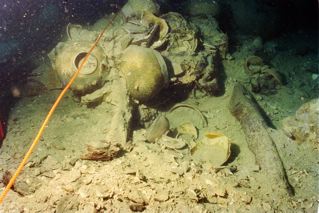
The adventures of Aladdin and Ali Baba and the Fourty Thieves in One Thousand Nights and One Nights are amongst our most cherished childhood stories, but what if they weren’t entirely make believe? From the improbable setting of the bottom of Indonesia’s Java Sea has risen 21st-century archaeological DNA that puts the oceanic adventures of Sinbad the Sailor across Africa and Asia in a real world historical context. The wreck of the first Arab dhow discovered in Southeast Asian waters has produced clear evidence for direct trade between the Arab world, the western Indian Ocean and China during the latter part of the first millennium.

From striking an isolated reef off Indonesia in the 9th century AD to its display this month in Singapore’s futuristic ArtScience Museum, the Belitung cargo has finally reached port. Shipwrecked: Tang Treasures and Monsoon Winds is a major exhibition organized jointly by the Smithsonian’s Freer Gallery of Art and the Arthur M. Sackler Gallery in Washington, the Singapore Tourism Board and the National Heritage Board of Singapore that will crisscross the globe in the next five years from Asia to the USA, Europe and Australia, before the ship docks ‘home’ in the Near East a millennium late. Just when the wreck’s salvation from oblivion should be secure and celebrated, like the storm-struck mythical Sinbad himself the physical wreck is again sailing troubled waters.

The 9th-century AD Belitung wreck. Photo: courtesy of the Freer Gallery of Art & the Arthur M. Sackler Gallery, Washington.

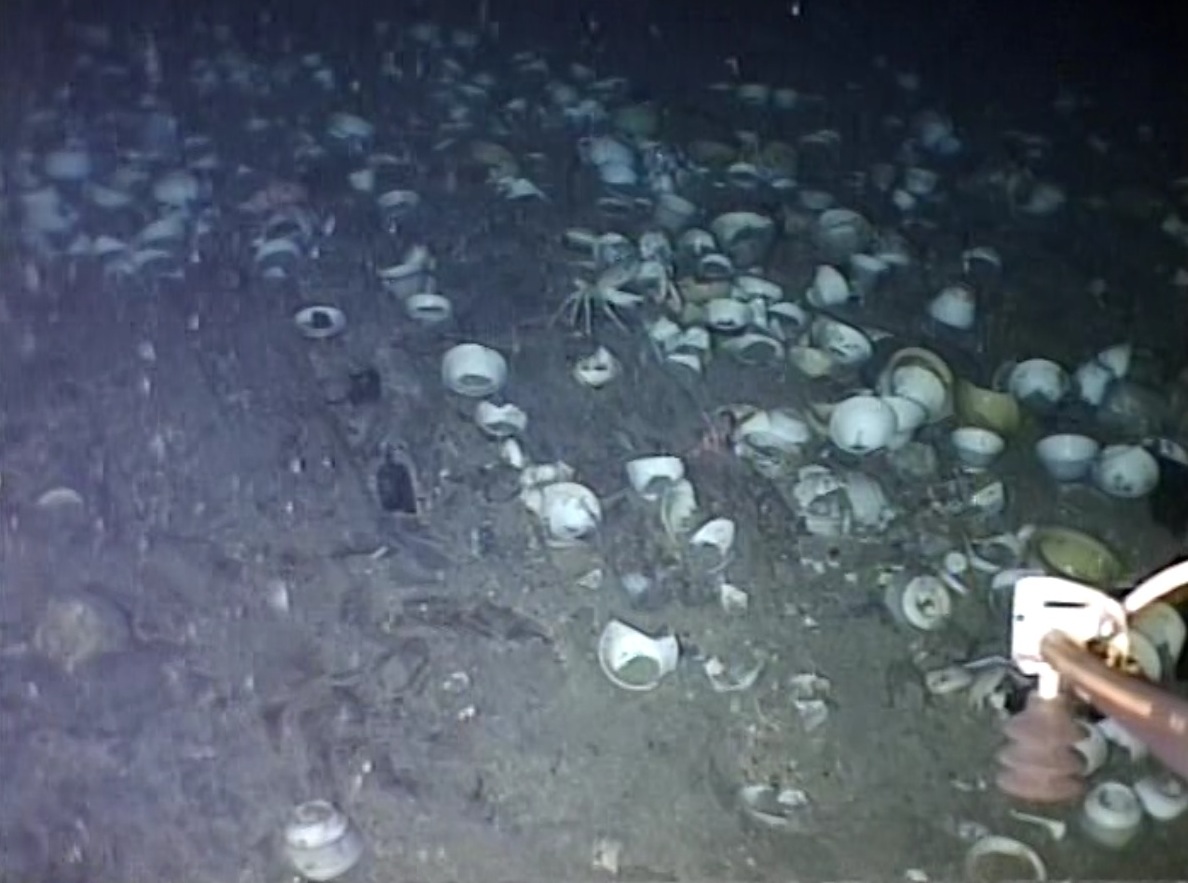
The Belitung wreck was tracked down by Seabed Explorations in 1998, when the German company was awarded an excavation license by the Indonesian government. The fieldwork was completed in 1999 and the majority of finds sold in 2005 to the Sentosa Leisure Group for $32 million. A million miles from the spot where the Belitung cargo and hull were at risk from destruction at the hands of looters and fishermen, some Washington scholars are now criticizing the current show for endorsing commercial wreck recovery. Ted Schultz, chair of the National Museum of Natural History Senate of Scientists, believes that “substantial scientific information was lost due to the methods employed” during the excavation. Bruce Smith, a Curator at the Smithsonian’s National Museum of Natural History, similarly concludes that “this exhibition would send a very bad message to the public, that the Smithsonian doesn’t stand for the preservation of archaeological resources and that mining archaeological sites is OK.”

These few noisy critics see the recovery of the Belitung wreck as ‘treasure hunting’, which flies in the face of the UNESCO Convention on the Protection of the Underwater Cultural Heritage’s demand that “underwater cultural heritage shall not be commercially exploited”. Are these scholars ethically right to be affronted by the decision to promote this old ship in a travelling exhibition?

From Baghdad To Belitung


The 9th-century AD Belitung wreck. Photo: courtesy of the Freer Gallery of Art & the Arthur M. Sackler Gallery, Washington.

Here’s an alternative way of looking at these turn of events. In the late 20th century local fishermen chanced upon a pile of porcelain at the bottom of the Java Sea and saw a good opportunity to turn a quick buck for their impoverished families. Petty pilfering was nothing new. Shipwrecks off Indonesia are almost always discovered inadvertently by trawlers or line fishermen in open water and by aquarium fish divers and dynamite-fishing divers close to reefs. On this occasion in 1998 it was a sea-cucumber diver who first started harvesting artifacts from the Belitung wreck.

Through the grapevine Seabed Explorations got wind of some old pots and pans that stood out from the majority of ceramics fished up off Indonesia and secured the rights to the site. Such permissions do not come lightly or cheaply. Licences at times have to be rubber-stamped by 22 different government departments, which receive 50% of the salvaged cargo, usually based on proceeds of sale. This political choice is how many countries with low or no funding streams for underwater cultural heritage choose to operate in the Far East.

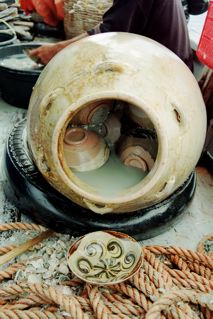
Even as the wreck excavation proceeded, the site remained at risk. When work closed down during the monsoon season, local divers immediately moved in, sometimes at night, and looted the site once more. Holes were smashed into the sides of large ‘Ali Baba’ jars stacked with hundreds of Changsha bowls that were otherwise too heavy to plunder. Unlike so many wrecks lost to man and machine that we never get to hear about off Southeast Asia, the ship’s narrative nevertheless could be reconstructed thanks to the excavation.

The same is sadly not true for numerous other cases. When the Desaru shipwreck was found off Peninsular Malaysia in 2001 by Nanhai Marine Archaeology, its upper structures and cargo had already been “shaved flat” by trawlers. Despite the placement of a hazard warning buoy over the site, a year later the trawlers were back and archaeologists found the seabed covered with broken planks, displaced bulkhead frames and a long steel chain and parts of a trawl net snagged on the timbers. Three heavy longitudinal beams belonging to the mast support had completely vanished. The energy, politics and personal dedication that go into saving shipwrecks off Southeast Asia are easily overlooked from the comfort of dry land in Washington, where perhaps the risks and realities of fieldwork cannot be easily visualized.

The 9th-century AD Belitung wreck. Photo: courtesy of the Freer Gallery of Art & the Arthur M. Sackler Gallery, Washington.

The destruction of the Belitung wreck by dynamiting, trawling or looting would have been a cultural catastrophe. As John Guy, Senior Curator of South and Southeast Asian Art at the Metropolitan Museum in New York, put it, “Sometimes, an event occurs which dramatically enlarges the boundaries of our knowledge… The discovery of the Tang shipwreck is one such event. This cargo is the most important hoard of Tang artifacts ever discovered at a single site.”

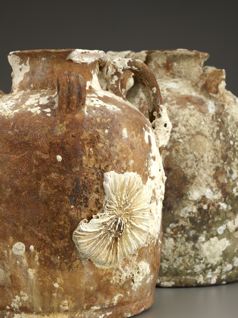
This wreck is literally a one-off. The 60,000 Tang-period objects conserved in Indonesia and New Zealand have rightly been described as the most important marine archaeological discovery ever made in Southeast Asia. The ship’s cargo mostly comprised Chinese ceramics from the kilns of Changsha in Hunan, with a small consignment of fine Yue white-and-green-splashed ware. Three blue-and-white dishes are the earliest intact examples of the Chinese style ever found. Large green-glazed jars from Guangdong were used to stow some of the Changsha bowls, as well as perishable goods.

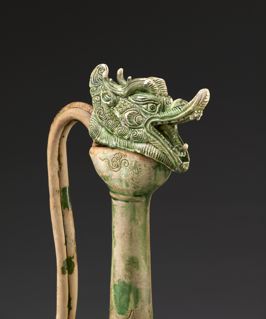
The cargo includes 763 identical inkpots, 915 spice jars and 1,635 ewers apparently made to order in at least five kilns strewn across China. There was nothing provincial about the eclectic cargo, which cleverly catered for the global market – something for everyone. Some objects featured Buddhist lotus symbols and motifs from Central Asia and Persia, while geometric decorations and Koranic inscriptions were clearly geared towards Islamic markets.

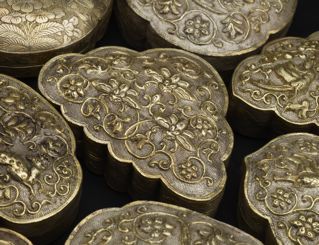
What is so original about the Belitung wreck is that this was no bulk-carrying Chinese junk, examples of which are well known. Alongside the mainstream ceramics were exotic wares and gold and gilt-silver vessels, perhaps imperial gifts. A Persian dancer clapping her hands above her head and musicians playing various instruments adorn the largest Tang dynasty gold cup ever discovered. A pair of mandarin ducks decorating a silver flask, symbols of matrimonial harmony, and the repeat presence of pairs of birds, deer and ibexes on other ornamental boxes point towards these exotic gifts being shipped to the Persian Gulf for a royal wedding. An incised Chinese bowl dates the probable year of the voyage to AD 826.

Detail of a monumental ewer, 9th-century AD Belitung wreck. Photo: courtesy of the Freer Gallery of Art & the Arthur M. Sackler Gallery, Washington.

The Belitung cargo may be entirely Chinese in origin, but unlike the common Chinese imports of pepper and spices, organic finds reveal that the vessel was also carrying Illicium verum, the Chinese export spice star anis. The ship was clearly outgoing rather than incoming. But to where? Dr Michael Flecker’s study and publication of the hull, with its 15.3 metre intact keel, reveals that the ship is similar to Arab dhows of the Middle East. External hull planks and internal frames were all lashed together with cord, probably coconut-husk fiber. This form of technology evolved in the reef-strewn shallows of the Red Sea and Persian Gulf with its small, high-energy breaking waves by giving vessels greater flexibility than ships built with wooden dowels or iron nails. Crucial analysis of the wood species by Professor Nili Liphschitz of the Institute of Archaeology at Tel Aviv University identified the frames, stempost, hull planks, anchor shank and dunnage all to have relied on Afzelia Africana, African mahogany. Dr Flecker argues convincingly that the Belitung ship was most probably constructed in Yemen or Oman in the Middle East, where traditional sewn-plank boats had been in use since Roman times.

Through a single site excavation, the Belitung wreck has revolutionized what we thought we knew about Early Islamic long-distance trade. In the history of marine archaeology it is to Southeast Asia what the Late Bronze Age Cape Gelidonya and 7th-century AD Yassi Ada sites are to the Mediterranean Sea in terms of groundbreaking new data about respectively Canaanite trade and the all-encompassing use of mortise-and-tenon technology for shipbuilding.

In the 9th-century the world economy was driven by two powerful engines: Tang dynasty China, an empire stretching from the South China Sea to the borders of Persia, and Baghdad, capital of the Abbasid dynasty from AD 762 onwards, that controlled peoples and commerce as far as the Indus River to the east and Spain to the west. Until the Belitung wreck came to light, historians assumed that Tang China trade pounded the dusty Silk Road though Central Asia. We now know that a more efficient Maritime Silk Route linked these two economic powerhouses. The latest research suggests that the Belitung wreck was outward bound from Guangzhou to the Middle Eastern port of Al Basrah, modern Basra in Iraq, the home country of Sinbad the Sailor, when disaster struck.

Saving the Deep

Changsha ewers from the 9th-century AD Belitung wreck. Photo: courtesy of the Freer Gallery of Art & the Arthur M. Sackler Gallery, Washington.

So here’s how I envisage the Belitung shipwreck. A site of the highest international importance, saved by the passion for the past and commercial astuteness of the government of Indonesia and Seabed Explorations that is turning on its head though fresh primary data centuries of historical presumptions – exactly what archaeology is supposed to do. Who could have foreseen, for instance, that in the ship’s three cobalt-blue underglaze painted dishes – a decorative scheme previously known from the Middle East, but not China in this period – that the Belitung wreck would reveal a likely Iraqi inspiration for China’s eventual ‘trademark’ blue and white porcelain that went on to rule the world.

No excavation on land and especially conducted beneath the sea is ever perfect, and I see no evidence that crucial information was lost at Belitung in the search for shiny stuff. The part of shipwrecks that critics of commercial ventures often rightly argue are destroyed or dismissed, the hull, has already been long published by Dr Flecker in an international journal. Was key data really lost during the underwater dig or was it just the commercial angle of the site’s management that left a Tang taste hanging over some of Washington’s ivory towers?

The Belitung wreck is not just a cracking discovery, it is also a symbol of cross-border unity, which I find uplifting and encouraging: an ‘Arab’ ship sailing from China to the Islamic Middle East excavated by a German company under Indonesian license, whose crucial wood identification was achieved by a Jew in an Israeli university laboratory. Doesn’t that sound like a fitting definition of Rule 8 of the Annex of the UNESCO Convention on the Protection of the Underwater Cultural Heritage, whereby “International cooperation in the conduct of activities directed at underwater cultural heritage shall be encouraged in order to further the effective exchange or use of archaeologists and other relevant professionals”?

Silver boxes from the 9th-century AD Belitung wreck. Photo: courtesy of the Freer Gallery of Art & the Arthur M. Sackler Gallery, Washington.

As George Yeo, Singapore’s Minister for Foreign Affairs, said in his opening speech to the ‘Tang Treasures’ exhibition at the ArtScience Museum, becoming the second government to give the wreck project the seal of approval, “In that cargo, sitting side by side, were Buddhist pieces and Islamic pieces. The mirror, which was an ancient mirror from the Han Dynasty, had the Ying-Yang, and the Taoist hexagram, the Ba Gua. They were all there. It was an age when different religions and different cultures met, and people rejoiced in trade. Those who invested in it, those who were a part of it, derived great wealth. So in a strange way, though the cargo is about the 9th century, it is also about the 21st century. And therefore I commend it to the world.”

Wrecks like these should be ‘feel good’ factors at times when the world has very serious and painful natural, economic and civil disasters to contend with. The world is imperfect and every day below the waves cultural heritage gets sacrificed as a by-product of dredging, fisheries and even sea cucumber diving. As a poorly resourced discipline, truth be told marine archaeology needs all the help it can get to save even a miniscule part of the past. This is especially the case in Southeast Asia, where, as Dr Flecker has discovered first-hand, since “most wreck-sites are threatened with looting or outright destruction, the priority must be to document those sites and the artefacts recovered from them before too much information is lost. The disposition of the artefacts after thorough documentation, while of great importance, should not dictate policy, for if commercial transactions are banned outright, the finders will be driven underground, and there will be no hope of archaeological intervention… Until cultural awareness gains the upper hand over profits and politics, this may be the best argument to ensure that irreparable damage is not done to the non-renewable resource of historic shipwrecks in Southeast Asia.”

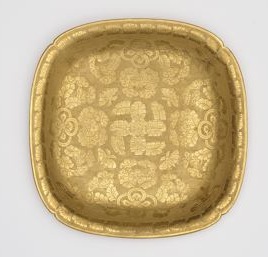
A gold plate from the 9th-century AD Belitung wreck. Photo: courtesy of the Freer Gallery of Art & the Arthur M. Sackler Gallery, Washington.

While it is healthy and right to question standards, from most enlightened perspectives the concern over Shipwrecked: Tang Treasures and Monsoon Winds is a storm in a teacup. It hardly needs stating that no European and American museum collection is whiter than white. Commerce emerges as an essential part of cultural resource management today, just as it has been in filling the world’s museums with wonders. Without Lord Carnarvon’s deep pockets we would have no tomb of Tutankhamun, and through Lord Elgin’s exuberance London would not be home to the Parthenon marbles, bought by the British government for £35,000 in 1816. Even today, reality dictates that international blockbusters call on the likes of Mitsubishi, Morgan Stanley, HSBC, BP and Credit Suisse to sponsor archaeological events for public education and entertainment. Like it or not, commerce defines real world cultural synergy.

Julian Raby, Director of the Freer Gallery of Art and Arthur M. Sackler Gallery, takes a long-term philosophical view of his new exhibition. “It is my sincere hope that this traveling exhibition… will encourage both the public and politicians in the ASEAN (Association of Southeast Asian Nations) region to value their maritime heritage”, he suggests. “The Singapore Government’s commitment in purchasing the cargo, and, surely, in creating a home for it on its return will hopefully be the catalyst for investment across the region in the structures and institutions that can best study and preserve the underwater archaeological record.”

Just as the distant memory of Sinbad the Sailor inspired for centuries One Thousand and One Nights, and future art and culture in the form of Rimsky-Korsakov’s Scheherazade, characters in James Joyce’s Ulysses and Edgar Allan Poe’s Thousand and Second Tale of Scheherazade, not to mention ‘Sinbart the Sailor’ in The Simpsons, so the Belitung wreck’s safe recovery from the deep might too be talked about by society for centuries to come.

Further Reading

Michael Flecker, ‘A 9th-century Arab or Indian shipwreck in Indonesian waters’, International Journal of Nautical Archaeology 29.2 (2000), 199-217.

Michael Flecker, ‘The Ethics, Politics, and Realities of Maritime Archaeology in Southeast Asia’, International Journal of Nautical Archaeology 31.1 (2002), 12-24.

Michael Flecker, ‘A 9th-century Arab or Indian shipwreck in Indonesian Waters: Addendum’, International Journal of Nautical Archaeology 37.2 (2008), 384-86.

Sean Kingsley, ‘The Unexcluded Past. Managing Shipwreck Archaeology’, Minerva 12.1 (2010), 37-44.

Sean Kingsley, ‘Into the Abyss: Deep-Sea Shipwrecks, Science & Scandal‘, Current World Archaeology 33 (February/March 2009), 34-43.

Regina Krahl, John Guy, J. Keith Wilson and Julian Raby (eds.), Shipwrecked: Tang Treasures and Monsoon Winds (Smithsonian Books, 2011).

Underwater Cultural Heritage & UNESCO in New Orleans(Odyssey Marine Exploration Papers 13, 2010).

Categories: Editorials | 3 Comments

Sunken America’s Holy Grail – Earliest Human from Mexico’s Black Abyss

A human skull found in the Hoyo Negro cave, Mexico. Photo: Daniel Riordan-Araujo.

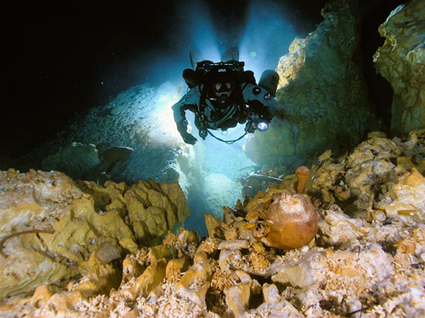
Deep within the flooded cave of Hoyo Negro, the ‘Black Hole’ in the Yucatan Peninsula of Mexico, explorers from PET (Projecto Espeleológico de Tulum) have possibly discovered America’s earliest human remains. After diving along 1,200 metres of underwater passages through an eerie submerged Ice Age landscape using underwater propulsion scooters, the team of Alex Alvarez, Franco Attolini and Alberto Nava touched down at a depth of 57 metres and started surveying a 60 x 36 metre cavern.

Near to several megafauna remains, including a mastodon bone, the team came across a sight that caught their breath. “I was searching for more of the mastodon remains”, recalled Alvarez, “when I saw what looked like a human skull. I had thought we already had a great discovery after finding the remains of several Pleistocene animals… but finding a human skull was totally amazing for us. All of our efforts… walking through the jungle, carrying all the gear, securing the helium required to do such a deep dive… paid off at that moment. This is the Holy Grail of underwater cave exploration.”

Remains of an extinct mastodon in the Hoyo Negro cave, Mexico. Photo: Daniel Riordan-Araujo.

Some 12,000 years ago at the end of the Pleistocene period, the Earth was rocked by great climatic change. As the ice caps melted, a global flood triggered a colossal rise in sea levels, which flooded low-lying coastal landscapes. Many of the underground spaces where for millennia animals had rested and taken on water, and where tribes escaped the sun and performed cultic rituals, were inundated.

Although radiometric dating of the bones is still pending, the bones found with the megafauna remains in Hoyo Negro could represent the oldest evidence of humans in the Americas. Guillermo de Anda, an archaeologist from the University of Yucatan in Merida, believes that “The findings of Hoyo Negro are a once-in-a-lifetime discovery. The skull looks pre-Maya, which could make it one of the oldest sets of human remains in the area… Therefore, protecting and learning the secrets of Hoyo Negro should be one of the main priorities for the archaeologists in the region.”

Detailed analysis of the human skeletal remains from Hoyo Negro, a site located inside the Aktun-Hu cave system in the state of Quintana Roo, is expected to help reveal when these Paleoindian peoples reached this area and, ultimately, who were the First Americans, one of the great mysteries in American archaeology.


Source: NatGeo News Watch.

Categories: News | Leave a comment

Odyssey’s Jacksonville ‘Blue China’ Wreck: a Mid-19th Century East Coast Schooner

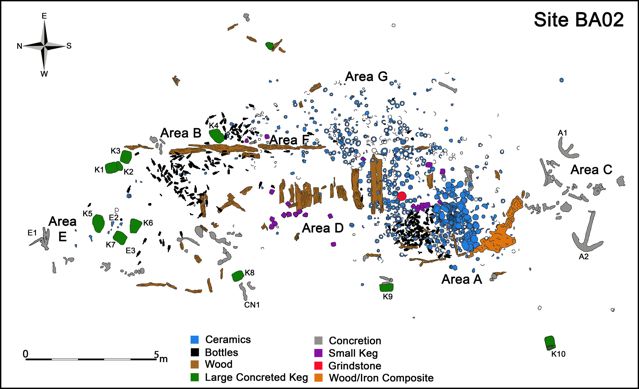
Plan of the 370 metre-deep Jacksonville 'Blue China' shipwreck (Site BA02), mid-19th century. Photo: © Odyssey Marine Exploration.

Just published – the first two reports by Odyssey Marine Exploration on its rescue archaeology on a mid-19th century wreck (Site BA02) lost at a depth close to 370 metres, 70 nautical miles off Jacksonville, Florida.

The wreck was brought to Odyssey’s attention in 2003 by a fisherman, whose nets had snagged ceramic wares over the last 40 years. A small selection of artifacts was recovered in 2003 and the wreck arrested in court. The site was revisited by Odyssey in 2005, when disturbing further impacts were documented, caused by recent dragging of trawl nets in the interim years by shrimp boats seeking fish for America’s booming sushi restaurants. Further diagnostic material culture was recorded in relation to its contexts prior to select recovery to identify and date the site before the wreck became even more extensively disturbed and data lost.

Lines of ceramics disturbed and cleared by trawl gear running across Site BA02. Photo: © Odyssey Marine Exploration.

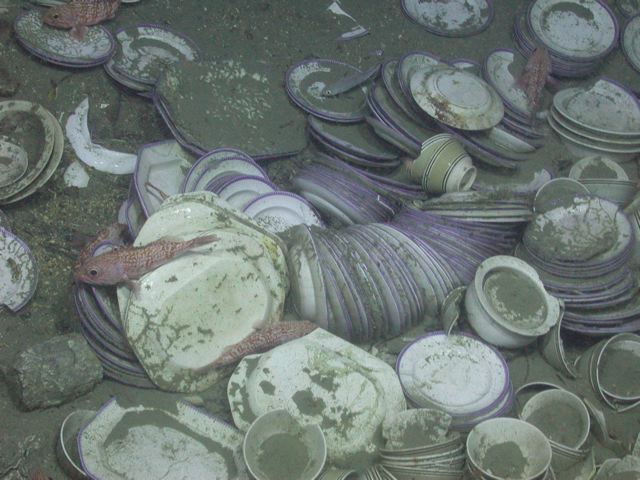
Site BA02 contains the remains of a small American coastal schooner that was transporting a consignment of British ceramics manufactured in Staffordshire in the decade 1850-60 alongside American glass wares and building materials. The most plausible theory is that the ship was lost in a hurricane, with the great storm of September 1854 the most likely candidate.

The vessel appears to have been a two-masted schooner typical of the East Coast’s thriving regional maritime trade based in New York City. The Jacksonville ‘Blue China’ shipwreck reflects the lure of high status, yet relatively cheap, Staffordshire and US products that prevailed across middle class America and permeated down into the lower classes. This is surprisingly the first wreck of any mid-19th century coaster found off America with a substantial cargo and reflects the roots of New York’s original mercantile and economic rise to urban stardom.

Two further reports on the Jacksonville ‘Blue China’ wreck’s tobacco pipes and glass wares will be published soon.

Download OME Papers 19 and 20 from Odyssey Marine Exploration’s website.

The only preserved stack of British shell-edged plates and platters on the 370 metre-deep Jacksonville 'Blue China' shipwreck. Photo: © Odyssey Marine Exploration.

Categories: News | Leave a comment

Moby-Dick Wreck Found in the Pacific

“No mercy, no power but its own controls it. Panting and snorting like a mad battle steed that has lost its rider, the masterless ocean overruns the globe” (Herman Melville, Moby-Dick, 1851).

*

The ship captained by the man whose adventures at sea inspired one of the great American novels, Herman Melville’s Moby-Dick, has emerged from the battered shallow reef where it sank on 11 February 1823, some 600 miles northwest of Honolulu. The Nantucket whaler the Two Brothers was under the captaincy of George Pollard Jr. when it struck the French Frigate Shoals in today’s Papahānaumokuākea Marine National Monument in the Pacific Ocean, at 139,797 square miles the largest conservation area under the US flag. After abandoning ship, the crew survived a harrowing night by clinging to the ship’s boats, fortunately to be picked up the next morning by another Nantucket whaler.

Just a few years earlier Pollard had earned infamous notoriety in 1819 as captain of another Nantucket whaling vessel, the Essex, which had the ill fortune to be rammed and sunk by an 85 foot-long spermaceti whale in the South Pacific.

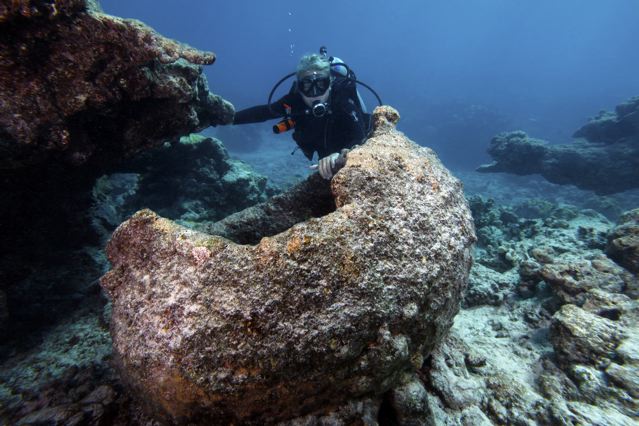
Dr Kelly Gleason with a whaling trypot off French Frigate Shoals. Photo: NOAA/Greg McFall.

As Owen Chase, First Mate of the Essex, would later recount in his Narrative of the Most Extraordinary and Distressing Shipwreck of the Whale-Ship Essex of Nantucket (New York, 1821), “He spouted two or three times, and then disappeared. In less than two or three seconds he came up again, about the length of the ship off… he came down upon us at full speed, and struck the ship with his head, just forward of the fore-chains, he gave us such an appalling and tremendous jar, as nearly threw us all on our faces. The ship brought up as suddenly and violently as if she had struck rock, and trembled for a few seconds like a leaf. We looked at each other with perfect amazement, deprived almost of the power of speech… the ship had settled down a considerable distance in the water, and I gave her up as lost”. During their trials on the sea voyage home, home George Pollard and his crew only survived by resorting to cannibalism as they drifted across an empty sea.

The Two Brothers was part of a fleet of several hundred whaling ships that played a major role in America’s economic and political expansion into the Pacific, transforming the region, including Hawaii, both economically and culturally. This colonialism resulted in the near extinction of many whale species.

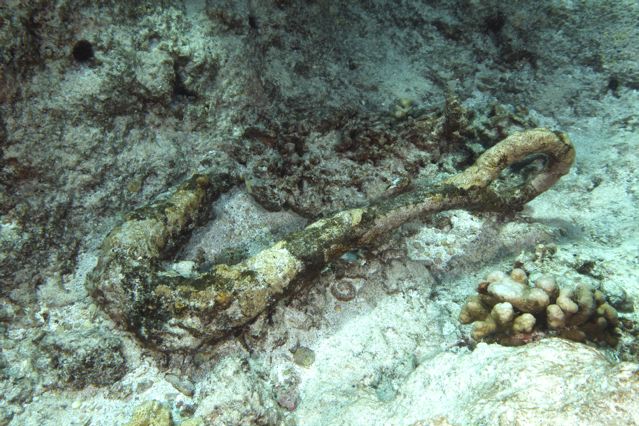
Dr Kelly Gleason with a blubber hook off French Frigate Shoals. Photo: NOAA/Greg McFall.

Marine archaeologists identified the scattered wreck, heavily pounded by the waves, through the survival of two large anchors, three cast iron trypots used to melt whale blubber to produce oil, and the remains of part of the ship’s rigging – all typical of the gear used on early 19th-century whalers. The location of the wreckage matched the general location of where the Two Brothers had grounded. The picture was confirmed by recent fieldwork that found blubber hooks, five whaling harpoon tips, three whaling lances, four cast-iron cooking pots and American ceramics and glass wares, confirming the date and nationality of the wreckage.

The 19th-century whaling industry was one of the most prominent businesses in America. By 1846, 736 whalers were based in the ports of southern New England and Long Island. Whales were thought of as swimming oil wells. The waxy oil derived from the head of the sperm whale, spermaceti, was highly prized for making the finest candles in the world. The bones and teeth of various species, meanwhile, were exploited for numerous products from collar stays to buggy whips, toys and even for springs in early typewriters. Baleen from the mouths of some species of whale was the de rigueur fashion accessory for the manufacture of ladies corsets. Whalebone was the plastic of the 1800s.

Dr Kelly Gleason with a ginger jar from the French Frigate Shoals whaler wreck of the Two Brothers, lost in 1823. Photo: NOAA/Greg McFall.

Categories: News | Leave a comment

Extreme Booze From the Deep

Examining a beer bottle from an early 19th-century wreck in the Baltic Sea. Photo: VTT Technical Research Centre, Finland.

If the 168 bottles of Veuve Clicquot and Juglar types of champagne recovered from an early 19th century wreck off the Åland archipelago at the bottom of the Baltic Sea are not to your taste – or at an expected $70,000 a pop don’t suit your wallet – fear not. It seems the ship, found between Finland and Sweden, catered for all tastes and occasions. Five bottles of beer from the wrecked schooner are now being heralded as amongst the world’s oldest preserved pints.

The VTT Technical Research Center of Finland hopes its analysis of a sample of the ‘pale ale’ will determine the original brewing recipe through identification of microbes, such as yeast or lactic acid bacteria. VTT scientist Arvi Vilpola has had a sneaky first gulp of the brew and reported that “It was a little sour and you could taste the saltiness of it slightly.” The team hopes to use these remains to bring the beverage back to life for modern consumers.

Chateau Jiahu, a Neolithic beer available from the Dogfish Head Brewery, Delaware.

All good fun, but for age this is literally small beer compared to the hard stuff knocked out by early Celtic revellers at Eberdingen-Hochdorf in southwestern Germany. Excavations in a series of 2,500 year-old ‘industrial’ ditches were stuffed with thousands of barley grains from high-quality barley malt, a key ingredient of beer.

Reconstructions of Celtic ceremonial boozing at the site by archaeobotanist Hans-Peter Stika of the University of Hohenheim in Stuttgart suggest that the barley was soaked in specially constructed ditches until it sprouted. The grains were then dried by fire, instilling the malt with a smoky taste. Lactic acid bacteria stimulated by the slow drying of the soaked grains added sourness to the brew. In the place of modern hops, the Eberdingen-Hochdorf brew was probably flavoured with spices like mugwort, carrot seeds or henbane. But beware: Prof. Stika warns that this drink would have been an “extreme beer”. Little wonder the Roman emperor Julian condemned Celtic beer as smelling “like a billy goat.”

Even millennia older than Celtic and Egyptian beer, however, is the 9,000-year-old hard stuff recreated by an American brewery after analysing the linings of Neolithic pottery found at a burial site in Henan province in central China. The brew was identified by Dr Patrick McGovern, a biomolecular archaeologist at the University of Pennsylvania, after he came across sherds from the Neolithic village of Jiahu in Henan province. The Dogfish Head Brewery in Delaware has started making Chateau Jiahu from wildflower honey, muscat grapes, barley malt, hawthorn fruit and chrysanthemums. The wort is fermented for about a month with Sake yeast until the $13 a bottle beer is ready for packaging.

This winter there’s plenty of options for all manner of adventurous tipples – salty malt, Billy goat beer or fruity Dogfish brew. Or you could just go down the pub.

Categories: News | Leave a comment

UK Maritime Funding Hits the Gravel

Photo: courtesy British Marine Aggregate Producers Association.

Hot on the heels of the government’s decision to abolish after 30 years of service the crusaders of Britain’s vast submerged heritage, the Advisory Committee on Historic Wreck Sites, the lid to marine archaeology’s limited resource coffers in the UK has closed some more. The ‘white knight’ that was the Aggregates Levy Sustainability Fund will disappear in a puff of smoke in March 2011.

This pot of silver earmarked for reducing the environmental impacts of the extraction of aggregates was a success story for a cog of marine science that has traditionally had to beg for funds at the bottom of the food chain. Gravel dredging is big business. The UK has the largest offshore dredging industry in Europe and is one of the biggest in the world. Figures for 2006 suggest an annual processed sale value of £293 million. The marine aggregates industry operates 28 purpose built dredgers with a total replacement value of £1 billion.

Some 138 square kilometres of the UK’s continental shelf was actively dredged in 2008 to provide aggregate for the building industry. The war chest levy was introduced in April 2002 at a rate of £1.60 per tonne, and since 2009 had stood at £2.00 per tonne to enable the effects of dredging on shipwrecks and submerged prehistoric settlements to be modeled and managed.

According to DEFRA, “We have had to look very carefully across all the Department’s priorities to see where we can make best use of available funds in a very tight spending context. Unfortunately, the Department is no longer in a position to be able to continue the funding of the ALSF programme.” It is unclear how these funds are to be otherwise ‘prioritised’.

All seemed to be running particularly smoothly. The ALSF 2008-11 Evaluation concluded only in 2010 that “The Fund will generally deliver good value for money with potentially more significant gains in the longer term… The ALSF is now a mature programme with considerable momentum behind it, a good reputation and a wide community of interest. In some areas it has an influential European and international profile…”

You only have to peer over the sea to Holland’s Flushing wharf, where recent dredging has brought up 16th-century coins, boat and ship fittings, a British aircraft part, anchors and mammoth teeth – all declared to Wessex Archaeology – to see the value of this excellent scheme. In the UK, Wessex Archaeology reported the discoveries in 2009 and 2010 of a Roman mortaria in Licence Area 107 off Lincolnshire and a collection of late 18th-century hallmarked silver dredged from Licence Area 254 bearing the crest of the 6th Earl of Stair, John Dalrymple (1749-1821).

A Mesolithic site of around 8,500 BC off Great Yarmouth only came to light after a Dutch dredger declared the discovery of wood, bone, antler and struck flint. Since 2005 Wessex Archaeology has secured filings on 784 finds dating from the Palaeolithic period to the modern day. Hopefully the Awareness Programme that has so successfully monitored landings of dredged underwater cultural heritage, and generated great interest amongst ‘Site Champions’ on the wharves where the dredgers land, will find another income stream and live on.

Defra’s mission statement says that “We deal with environmental risks and work towards securing a sustainable society and a healthy environment.” What does the latest development tell us about the sustainability and health of underwater cultural heritage? The £2,715,759 that the ALSF allocated English Heritage in 2005 for various multi-year projects may seem like a cheap investment if an intact wooden wreck sunk in the middle of an aggregate licence area demands future rescue excavation. What price the sunken past?

Categories: News | Leave a comment

Blog at WordPress.com.

Design a site like this with WordPress.com
Get started